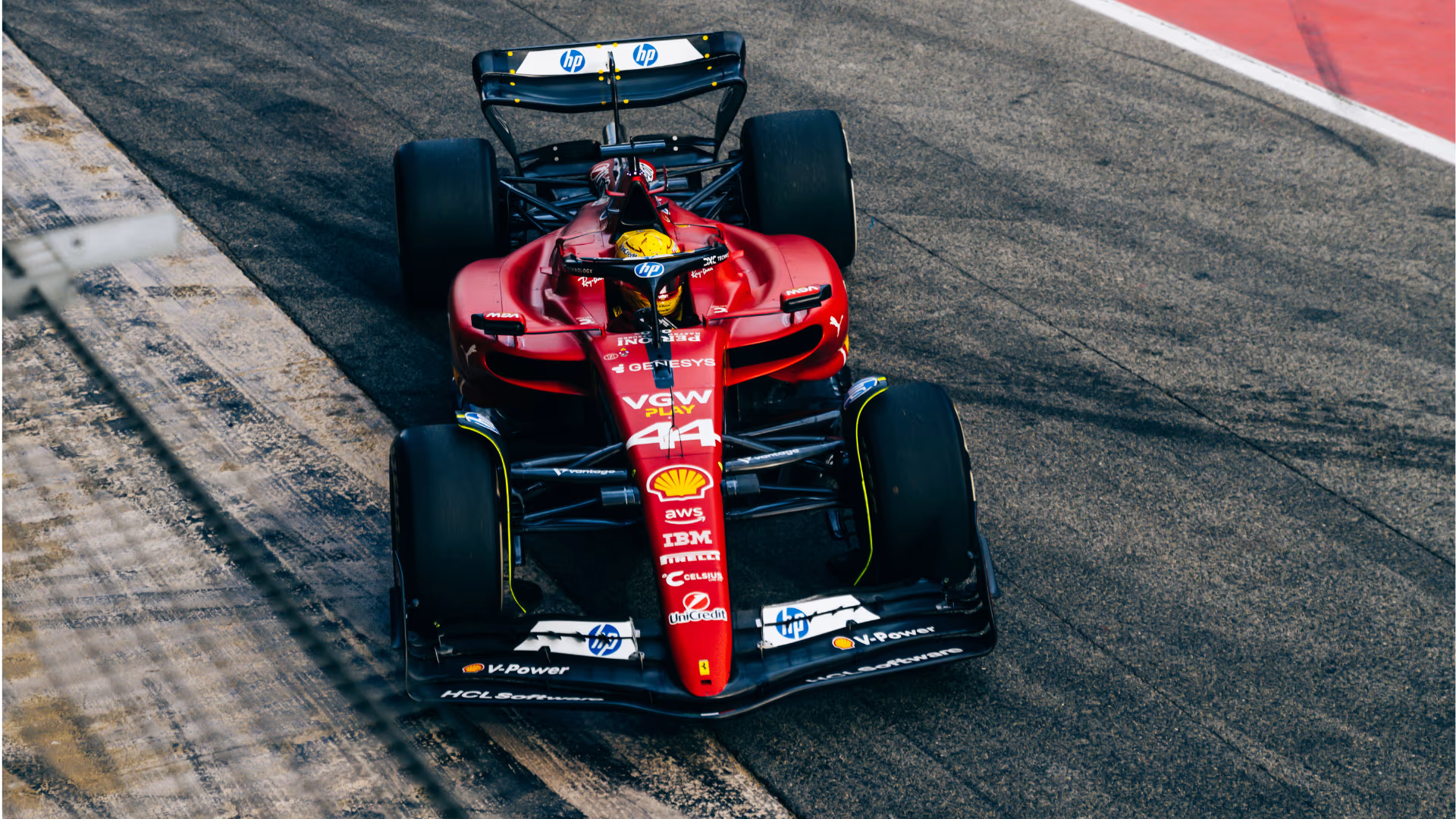
After 16 months without a podium finish, Lewis Hamilton ended his longest drought as a professional racing driver by crossing the line third at the Chinese Grand Prix in Shanghai, his first grand prix rostrum as a Ferrari driver in 26 attempts.
For a man who has spent the better part of his adult life on Formula 1 podiums, the moment carried an unusual weight — heavier, arguably, than many of the victories that came before it.
What makes Hamilton’s early-season form particularly striking is the contrast with where he was just a few months ago. The closing races of 2025 saw him cutting an increasingly disconsolate figure in the paddock, struggling to match Charles Leclerc’s pace and visibly uncomfortable in a car that never fully spoke to him. That version of Hamilton has not shown up in 2026.
Much of the credit, according to those around him, goes to the new technical regulations. The 2026 cars are narrower, lighter, and split their power output roughly equally between combustion and electrical systems, and Hamilton has taken to them immediately. Former F1 driver and Sky Sports analyst Anthony Davidson described the shift from the first test in Barcelona: “From the word go in the Barcelona Shakedown, he said: ‘this thing actually talks to me, I can get a read on what it’s going to do, I like the way it moves around’ and he responds well to that.”
Davidson’s observation points to something deeper than just raw pace — it speaks to a driver’s confidence in his own ability to shape what the car does beneath him. The ground effect cars of the previous era reportedly denied Hamilton that sensation, which went a long way toward explaining his loss of form in qualifying. That problem appears to have disappeared entirely in 2026.
What proved most illuminating in Shanghai, beyond the podium itself, was the wheel-to-wheel battle Hamilton sustained with Leclerc throughout the second half of the race. The pair changed positions repeatedly across multiple laps, making contact only once — lightly enough for Hamilton to describe it as “a kiss.” He went on to describe the whole experience as “the best racing I’ve ever experienced in Formula 1,” which is a substantial claim from someone who has raced at the highest level for nearly two decades.
Ferrari principal Fred Vasseur was measured but encouraging in his assessment afterward, crediting Hamilton’s deeper involvement in the car’s development as a key factor. Unlike his first season, when he joined a project already well advanced, Hamilton was embedded in the SF-26’s development from the simulator stage in mid-2025. That intimacy with the machine appears to be paying off in a way that no amount of in-season adaptation could have replicated last year.
The competitive picture still requires honesty, though. Hamilton’s third place in China came with the asterisk that Mercedes was operating at a noticeably different level. Antonelli won by a margin that pointed to genuine pace superiority, not track position or strategy. Hamilton himself acknowledged that Mercedes holds somewhere in the region of four to five tenths over Ferrari in race trim, a gap he described as requiring “downforce, efficiency and power” improvements simultaneously to close.
Still, arriving at the Japanese Grand Prix third in the Drivers’ Championship — having already matched his entire points tally from the first five rounds of 2025 in just two weekends — represents a genuinely changed picture. The question heading to Suzuka is whether Hamilton and Ferrari can begin putting genuine pressure on the Silver Arrows, or whether the Shanghai podium was, for now, the ceiling of what the SF-26 can realistically offer.
Davidson’s read on the broader implications feels right: a happy, competitive Hamilton is good for the sport as a whole. Last year’s gradual deterioration of his public demeanour was worrying to watch, and even the most casual F1 follower could sense that something fundamental was off. That version of events now looks definitively over, which is the best news Ferrari could have hoped for heading into the third round.
What comes next matters enormously for the championship narrative. A Suzuka result that consolidates Ferrari’s second-place standing, even without threatening Mercedes’ lead, would confirm the season’s early hierarchy while keeping Hamilton in a mathematically relevant position heading into the long break that follows.