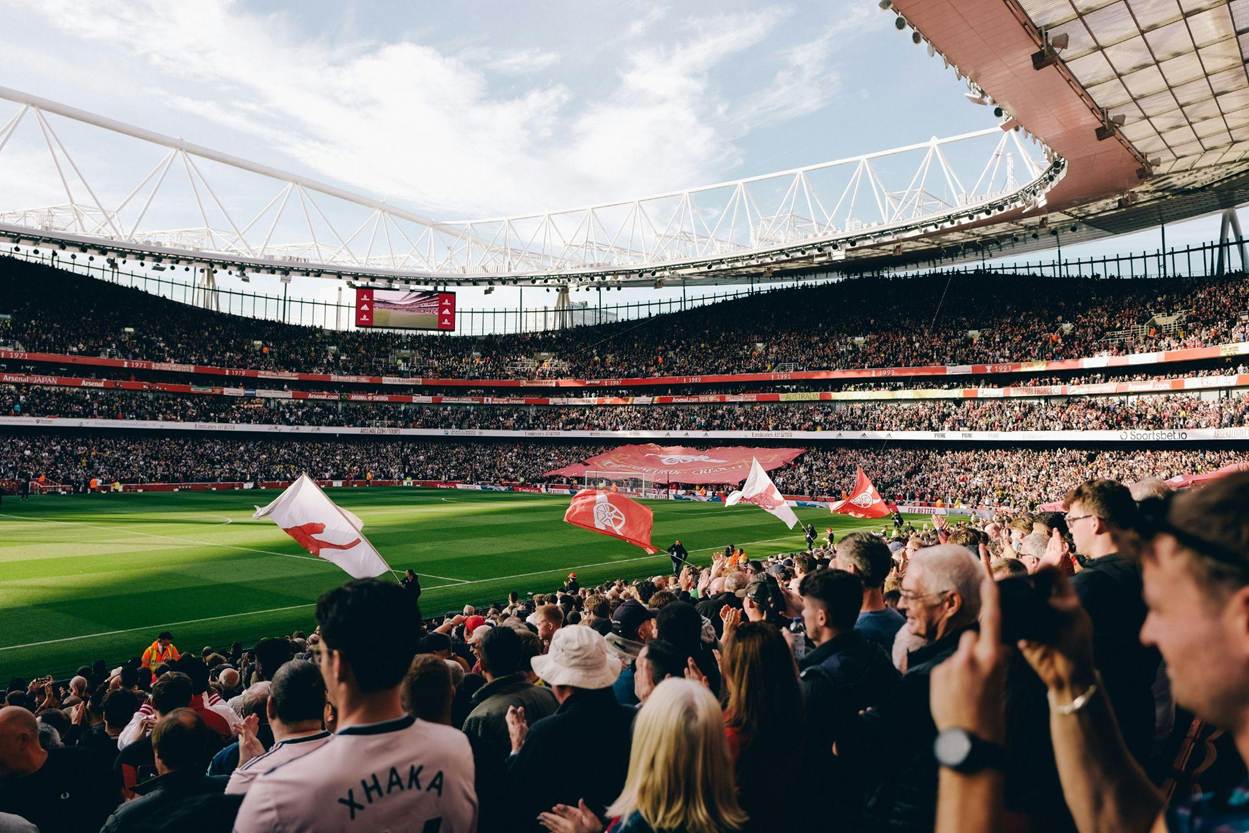
Arsenal scored more goals from set-pieces than any other Premier League team last season, and somehow that became a criticism.
Apparently, scoring from a corner does not count in quite the same way as finishing a 20-pass move. Nobody has explained why. The goal still goes on the scoreboard, and the points remain exactly the same.
Mikel Arteta will not be concerned about how those goals are judged outside the club. Arsenal’s set-piece work played a major role in winning the 2025/26 Premier League title, particularly when opponents made open-play chances difficult to find.
The Gunners scored 24 league goals from set-pieces, including a competition-record 18 from corners. Those numbers did not come from repeatedly putting the ball into the box and hoping for the best.
Corners Helped Arsenal Break Stubborn Opponents
Fourteen of Arsenal’s corner goals gave them a 1-0 lead.
That tells us far more than the overall total. Arsenal regularly face teams willing to sit deep, protect the middle, and challenge Arteta’s players to find a way through a crowded penalty area.
Those matches can become frustrating. Possession builds, crosses are blocked, and every passing move seems to end with another defender clearing the ball. A corner gives Arsenal a fresh opportunity without allowing the opposition to move up the pitch.
Before the Champions League final, Gooner Daily covered Rio Ferdinand’s belief that this strength could cause serious problems for Paris Saint-Germain.
By that stage, Arsenal’s set-pieces were no secret. Opponents knew exactly how dangerous they were and still found them difficult to stop.
Luck Only Explains So Much
There is always some luck involved in football. A clearance can hit another player, a shot can take a deflection, and a loose ball can fall perfectly for someone waiting inside the box.
That does not explain 18 corner goals across a league season.
Football supporters are already familiar with the difference between probability and certainty. Betting odds may change after team news or increased market activity, but they cannot guarantee a result. The same applies to the information provided with Jackpot City’s online slots, where RTP and volatility describe long-term return and payout patterns rather than revealing what the next spin will produce.
Arsenal cannot know exactly where every cross or clearance will land either. What they can do is increase their chances by practising the delivery, coordinating the movement, and sending several players towards the areas where the ball is most likely to arrive.
Luck may influence one goal. It does not explain a Premier League record of 18 corner goals in one season.
Rice and Saka Made the Difference
The planning would mean little without players capable of delivering the ball accurately.
Declan Rice and Bukayo Saka were outstanding from corners during the title-winning campaign. According to the Premier League, eight of Arsenal’s corner goals came from Rice deliveries, and another six came from Saka.
Their deliveries gave Arsenal variety. Rice could drive the ball into a crowded six-yard box, while Saka’s left foot created a different angle from the opposite side.
Gabriel was directly involved in five corner goals through his goals and assists. William Saliba, Jurrien Timber, Mikel Merino, and Kai Havertz added further height and strength.
Stopping all of them is difficult enough. Doing so while following blockers, runners, and changes in delivery makes the task even harder.
Arsenal Should Keep Using Every Advantage
Arsenal still need to create more from open play in matches where their passing becomes predictable. That is a separate issue, and one Arteta will continue working to solve.
It does not make set-piece goals less valuable.
The best teams do not reject an effective method because rival supporters find it unattractive. They keep using it until somebody discovers how to stop them.
Arsenal’s corners were organised, varied, and repeatedly decisive last season. Calling them lucky may make opponents feel better, but it does not explain what happened on the pitch.